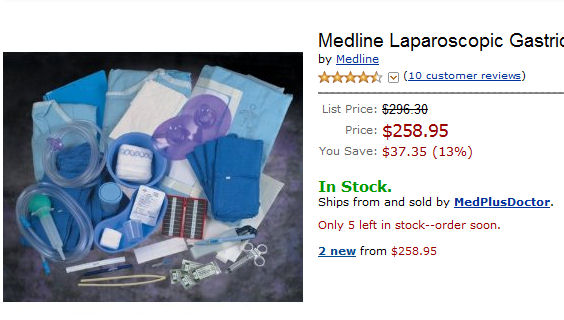
Are you seriously overweight and want a Gastric bypass operation? Your insurance doesn't cover it or you have no insurance? Try this at Amazon.com (NOTE: Anesthetic not included):
Obesity is a problem in the United States, and it's not a secret. Gastric bypass surgery is a radical, often last-ditch effort to "cure" the problem, and apparently some have decided that it's not something that requires a doctor: there appears to be a DIY kit available on Amazon.com.
Just to be clear, there are two sellers available, but the kit isn't sold by Amazon.com (or fulfilled, either), so Amazon Prime is not an option. Including shipping, the kit will run you about $280, but the item really includes 3 kits, in case you get it wrong the first time. There is no anesthesia included, so you'll have to get that somewhere else.
It has a buyer rating of 4.5 out of 5. However, some have reported the instructions are not very clear. The fact that they insert 3 kits in the one item may be seen as a comfort, as you will have multiple tries. It is similar to the case with screen protectors, we assume, where it is almost a requirement that more than one attempt be made.
In reality, a look at the reviews show that all are tongue-in-cheek. That said, because of that we have no idea how the kit is really rated. Just remember, since it's not sold by Amazon Prime, you have to rely on Amazon's Marketplace policy for returns, which is not as liberal as its own. If you have an experience with the kit, please leave a review at Amazon.com, or in our own comments, below.
To see the comments, click on the article title.
BTW, this item is no longer available. Sorry, fatty!
Once again, let's hear it for Saudi Arabian justice!
It seems the doctors don't object to this. Just remember that the next time you go into surgery.
And perhaps just as alarming (to me, anyway) Amnesty International, of which I am a member, is suggesting that he just be fined or flogged. I have already posted in this blog about flogging. Go figure.
SAUDI ARABIA: Human rights group urges authorities to flog crime suspect instead of imposing spinal cord punishment
August 21, 2010 | 7:30 am
You know a country's human rights situation is bad when even Amnesty International is urging that a guy be methodically whipped or caned on his back as a compromise to avoid an even harsher sentence.
Human rights monitors have grown alarmed over the case of a Saudi man who might have his spinal cord severed as punishment for badly injuring another guy during a fight a few years ago.
Amnesty International has urged Saudi Arabian authorities not to deliberately paralyze the man as a form of retribution for injuries he allegedly caused with a cleaver during a fight.
"We urge the Saudi Arabian authorities not to carry out such a punishment, which amounts to nothing less than torture," Hassiba Hadj Sahraoui, acting director of Amnesty's Middle East and North Africa Program, said in a statement. "While those guilty of a crime should be held accountable, intentionally paralyzing a man in this way would constitute torture, and be a breach of its international human rights obligations."
According to Amnesty International, a court in the northwestern Saudi Arabian town of Tabuk had asked hospitals whether they could mutilate the man's spinal cord as requested by his alleged victim. One hospital apparently said it could create the injury.
Amnesty said the court could decide not to impose the punishment and instead sentence the suspect to jail, hand him a stiff a fine or at the very worst, systematically whip or cane him on the back.
Basically, Amnesty, among the world's leading human rights groups, is advocating one form of torture in place of an even more horrific punishment.
The man's name has not been publicized. He was originally sentenced to seven months in prison. Amnesty says he was tried without a lawyer.
Two posts in one day. These things usually come in threes. We'll see.
I heard on the news about this dude who had a pea growing in his lung. That was too good to ignore so I goggled on "pea plant in lung." Yups, here's gramps and gramma, too, discussing this weirdness. Honest, I couldn't make this up. How could he aspirate something as big as a pea? From NBC New Health Check
Since a stroke a while back, I have some trouble aspirating food. I guess I'll be very careful to cough it all up, especially when eating raw seed things. And I might stop eating radish seeds entirely.
Lots of women have mixed feelings about their breasts. We push them up, strap them down...but at the end of the day, they're a part of our bodies and ourselves. Unfortunately, mothers in Cameroon have waged war against these buds of womanhood.
Girls' breasts are pressed on with hot stones to make them less attractive, a painful procedure than can cause bruises, deformities, abscesses, and even the disappearance of one or both breasts. Breast ironing starts at the first onset of puberty, and as diet in Cameroon improves, girls are starting puberty at a younger age. Girls as young as nine are having hot stones pressed against their breasts. »
This is a post I hoped I would never write. As you, my readers, know, I practice the virtue of chardi kala, translated in many different ways, but all having the meaning of eternal optimism and never giving up. I am still practicing, but it is hard.
No doubt by now you have heard about the massive oil spill by British Petroleum in the Gulf of Mexico in the Caribbean Sea, truly a paradise on earth. Or at least it was until 20 April 2010. On that day the Deepwater Horizon oil rig - owned and run by British Petroleum - exploded, caught fire and began gushing massive amounts of crude oil into the pristine waters around it. Eleven were killed and 17 injured. That was tragic, but it is just the beginning.
The amount of oil gushing into the Gulf is estimated at somewhere between 1,475,000 and 4,200,000 gallons per day ( 5,583,432 and 15,828,729 liters/day). No one knows how much oil is in this well, how long it can keep gushing. Years or decades, if it is not somehow stopped. So far nothing has worked. In fact, efforts have actually made it worse.
Here's a nice little widget to help you calculate.
Those are pretty dry figures for most people, so here's a more graphic look. This is what the spill looks like right now (30 June 2010):
I realise that most of my readers really can't relate to southern Louisiana, so here is the spill in other locations where I have readers:
If I happened to miss your locale, go to Ifitwasmyhome to move the spill to wherever you live.
Perhaps you'd like to see it as it happens.
If that's not enough to bring it home to you, here are a few oil-soaked pelicans. I find this horribly painful to look at.
In addition, massive amounts of methane gas has been released into the water. This may well turn out to be even more dangerous than the oil. The methane depletes the water of oxygen, leaving all the sea life devoid of the element that is necessary to all life on earth. It is feared that the methane will cause a dead zone where nothing can live, possibly for decades. Also, scientists believe that a huge methane bubble is forming under the water. When it bursts, it could release a tsunami of 20-60 ft (6.1-18.3 m), certainly enough to engulf most of the Caribbean islands. For more information on the gas leak, go here: Gas Leak 3000 Times Worse Than Oil.
And, by the way, with our current technology we have no way to cap or contain the methane.
I guess that's not enough bad news. It is now hurricane season. (For those of you in Asia, those are typhoons.) There will be hurricanes. In fact, the first one is blowing right now. Hurricane Alex did not move close to the spill, but there will be another hurricane and another and another.
The next thing to consider is the ocean currents. The Gulf Stream is an ocean river that runs from the Caribbean to Europe.
Eventually this oil and methane and all their problems will reach Europe. They will also travel up the Atlantic coast of North America all the way to Canada and all points north. No one knows how much of the ocean will die. Certainly a large part of the Caribbean Sea will and it will take decades to recover. In the meantime the many people who make their livings along the Gulf, either fishing or in the tourist trade, have lost their means of livelihood. It is even possible that the land they live on will become uninhabitable. Bobby Jindal, the governor of Louisiana has been alerted that a mass evacuation may become necessary, if a hurricane again hits the state. It is likely that once gone, the people will not be allowed to return due to the toxic oil and gas along the coast.
The earth is one big ecosystem, based primarily on our oceans. If a large part of one ocean dies, that will have a cascade effect on the rest of the planet. How far could this go? Worst case scenario: Bye-bye. "Not with a bang, but a whimper." If you don't recognise those lines, they are the conclusion of T. S Eliot's poem, The Hollow Men. To hear the whimper go to PowerWithout Petroleum and listen hard at 0:25.
Best case scenario: the southern coast of the United States becomes uninhabitable for a period of time and much of the sea life in the Gulf of Mexico dies, with devastating consequences to the people who now live there. As it is impossible that there be no hurricanes in the season, we can be sure that the winds will carry the oil throughout the region, damaging all it touches. That damage cannot be estimated at this time, except to say it will be extensive.
This morning (1 July 2010), going through my inbox, I found this article in the daily UN bulletin:
Methane at 100,000 times normal levels have been creating oxygen-depleted areas devoid of life near BP's Deepwater Horizon spill, according to two independent scientists
As long as I can remember, the scientists have been screaming "Wolf!" alerting us to this or that which they claim is going to wipe us out. As I child I grew up with "nuclear annihilation." That was the biggie. There have been others: the hole in the ozone layer, swine flu (twice), bird flu, global climate change and I'm sure others that I have forgotten. And it seems, life causes cancer. There is truth in all these scientific assertions, but there was also something we could do to stop or at least alleviate the disaster. As I see it, this is different because we are helpless to do anything except pray. Of course, I am not a scientist, and the only way I see out of this is divine intervention. Even if the spill can somehow be stopped, we can do nothing about the methane. This is the time more than ever before that we need to dig deep within ourselves and find the high spirits, the chardi kala, that is a part of us. It takes courage to look tragedy in the face and carry on without panic or depression.
And what caused all this? Of course it was British Petroleum cutting corners on safety to save money and increase profit. It was Pres. Clinton who authorised the deep sea drilling. It was Pres. George W. Bush who so favoured the oil interests and permitted a lack of oversight to allow BP not to follow the safety measures. It was Pres. Obama who did not immediately step in to correct this corruption from the previous administration. But it was also all of us who are dependent on petroleum, who refuse to cut back on our usage, we who demand more and more. In the end, if we had not demanded this oil, if we had lost our lust it, BP wouldn't have been able to make the profit that drove them to build this rickety structure upon the rickety structure of our economy. So what now? We have learned why greed is such an evil thing. Whither our good, green beautiful earth?
I keep thinking about the ending of Dr. Strangelove. (A great movie. If you haven't seen it, I highly recommend you see it while you still can.)
Remain in chardi kala, my dear brothers and sisters!



 you have


